


 Reviewed by Sarah Law, Naturopathic Nutritionist

Does Shilajit Actually Work? What the Evidence Really Shows
Shilajit does appear to have genuine biological activity, but the clinical evidence supporting its health benefits is still limited and largely preliminary. Research suggests it may support testosterone levels, energy metabolism, muscle recovery, and cognitive function — primarily due to its high fulvic acid and mineral content. However, most human studies are small, short-term, and methodologically weak. The honest answer is: promising, but not yet proven.
- Shilajit contains fulvic acid and over 80 trace minerals, compounds with documented biological activity in laboratory and animal studies [8]
- A small human trial found shilajit supplementation increased testosterone levels by approximately 20% over 90 days in healthy male volunteers [2]
- Most shilajit clinical trials involve fewer than 100 participants, limiting the strength of conclusions that can be drawn
- Quality varies enormously between products — some commercial shilajit supplements have been found to contain heavy metals and inorganic contaminants [4]
What Is Shilajit and What Does It Contain?
Shilajit is a dark, resinous substance that forms over centuries as plant matter decomposes within the cracks of high-altitude mountain rocks, particularly in the Himalayas, Altai, and Caucasus ranges. It is not a single compound — it is a complex phytocomplex containing hundreds of bioactive molecules.
Fulvic acid is the primary active constituent, typically comprising 60–80% of processed shilajit by dry weight (Asphaltum Punjabianum review, 2024 [2]). Fulvic acid acts as a carrier molecule, potentially enhancing the bioavailability of other nutrients and demonstrating antioxidant properties in laboratory settings [8]. Shilajit also contains humic acid, dibenzo-α-pyrones, and a broad spectrum of trace minerals including iron, zinc, magnesium, and manganese.
The composition of shilajit varies considerably based on its geographic origin and how it is processed. A 2025 chemical analysis of 14 raw shilajit samples from Iran, India, Nepal, Kyrgyzstan, and Russia found significant variability in inorganic anion profiles between sources [4]. This variability is a genuine challenge for consumers — two products labelled "shilajit" can have meaningfully different compositions.
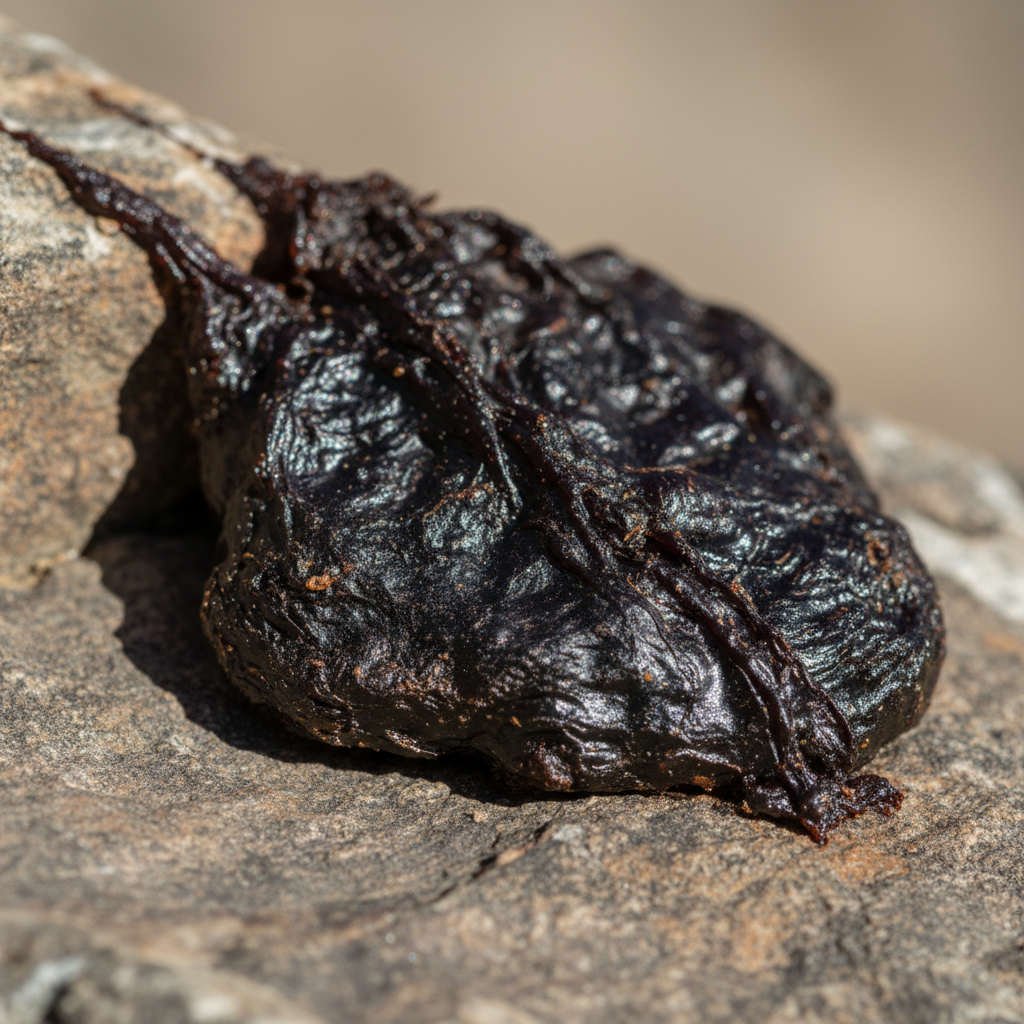 shilajit in its natural, unprocessed form — the raw material behind the supplement.
What Does the Clinical Evidence Actually Show?
Here's what the research actually shows: the clinical trial base for shilajit is thin, but not empty. Several small human studies have reported statistically significant effects across a handful of health outcomes. The problem is that "statistically significant in a small trial" and "clinically proven" are very different things.
A randomised, double-blind, placebo-controlled trial published in 2025 examined shilajit supplementation alongside chromium and Phyllanthus emblica in adults with metabolic syndrome risk factors over 12 weeks. Participants following an exercise and diet programme showed improvements in cardiometabolic markers, though it remains difficult to isolate shilajit's specific contribution given the combination formula used .
For muscle recovery specifically, a review of shilajit's mechanisms concluded it may reduce exercise-induced oxidative stress and support post-exercise muscle repair, likely via fulvic acid's antioxidant activity and its role in mitochondrial energy production [7]. However, no large-scale randomised controlled trials have confirmed this effect in healthy athletes at meaningful effect sizes. You can read more about the mechanism behind these claims in our article on what happens if you take shilajit every day.
The MEET® Shilajit clinical study — evaluating the specific branded ingredient formulation used in some standardised shilajit supplements — reported improvements across several physical and biochemical markers in a controlled setting [1]. This type of branded ingredient research is important because it tests the actual formulation, not simply a generic extract.
"Shilajit sits in an interesting position evidentially — it has real biological plausibility and some encouraging human data, but the trial quality isn't yet where we'd need it to be for firm clinical recommendations. I'd describe it as a supplement worth considering rather than one with proven, guaranteed outcomes."
— Sarah Law, Naturopathic Nutritionist & Functional Practitioner | Optimised Female

If you're looking to try Shilajit for yourself, our Shilajit Capsules formula is third-party tested, free from fillers, and made in the UK.
What Are the Shilajit Benefits That Have the Most Evidence?
Not all claimed shilajit benefits are equal. Some have more supporting evidence than others. Here is an honest breakdown.
| Claimed Benefit | Evidence Quality | Human Trials Available? | Verdict |
|---|---|---|---|
| Testosterone support | Moderate (small RCTs) | Yes — limited | Promising |
| Energy and fatigue reduction | Moderate (mechanistic + small trials) | Yes — limited | Promising |
| Cognitive/Alzheimer's support | Weak (lab/animal only) | Largely no | Too early to claim |
| Blood glucose management | Moderate (animal + small human) | Limited | Promising but unconfirmed |
| Antiviral / anti-cancer | Very weak (in vitro only) | No | Not supported in humans |
| Muscle recovery | Moderate (mechanistic reviews) | Limited | Plausible, needs more data |
| Cardioprotection | Moderate (evidence-based review) | Limited | Emerging evidence [3] |
The anti-inflammatory and antioxidant properties of fulvic acid have the strongest laboratory support . A 2024 review specifically highlighted shilajit's potential as an anti-hyperglycaemic, anti-obesity, and anti-inflammatory agent based on available preclinical and limited clinical evidence . However, the authors noted that human trials remain insufficient to support therapeutic recommendations.
For men specifically, the testosterone and fertility evidence represents some of the most-cited human data. We cover this in detail in our dedicated article on whether shilajit increases testosterone.
Are There Shilajit Benefits for Men Specifically?
Several of the most-cited shilajit benefits for men relate to reproductive health, physical performance, and hormonal support. A frequently referenced study found that 250 mg of purified shilajit twice daily for 90 days increased total testosterone by approximately 20% and DHEA-S by around 31% in healthy male volunteers aged 45–55 [2]. These are notable figures, though the sample size was small and the study has not been independently replicated at scale.
Sperm quality is another area of interest. A separate controlled trial found that shilajit supplementation improved total sperm count, motility, and normal sperm morphology in infertile men over 90 days. Again, sample sizes were modest, and replication in larger populations is needed before confident recommendations can be made.
Physical performance and fatigue resistance are frequently reported anecdotally by men using shilajit. The mechanistic rationale — improved mitochondrial function, reduced oxidative stress, enhanced mineral delivery — is sound [7]. However, the translation from plausible mechanism to consistent, measurable performance gains in well-designed trials has yet to be fully demonstrated.
If you are comparing shilajit to other adaptogenic supplements with a stronger evidence base, our complete guide to ashwagandha provides a useful point of comparison.
 The natural environment where shilajit is traditionally sourced and harvested.
Safety, Side Effects, and Who Should Be Cautious
Shilajit has a long history of traditional use, and available safety data are broadly reassuring when a high-quality, purified product is used. A dedicated safety study of Herbified® shilajit resin found no serious adverse events in participants over the study period, with the product demonstrating an acceptable safety profile [9]. However, raw or unprocessed shilajit is a different matter entirely.
Heavy metal contamination is the most significant safety concern. Analysis of commercial shilajit products has found measurable levels of arsenic, lead, mercury, and other potentially harmful inorganic compounds in some samples [4]. This is not a reason to avoid shilajit categorically, but it is a strong reason to choose products that are independently third-party tested and certified for heavy metal limits.
Additional safety considerations include:
- Raised uric acid levels: Shilajit has been associated with increased uric acid in some reports, which could be problematic for individuals with gout
- Iron overload: Due to its iron content, shilajit may not be appropriate for individuals with haemochromatosis
- Drug interactions: Shilajit may interact with diabetes medications (additive blood glucose-lowering effects) and antihypertensives; evidence is largely preclinical but warrants caution
- Pregnancy and breastfeeding: Insufficient safety data — avoid unless specifically directed by a healthcare provider
- Autoimmune conditions: Shilajit's immunomodulatory properties mean it could theoretically affect conditions where immune activity is already dysregulated
"Quality really does matter with shilajit — more so than with many other supplements. I always advise clients to look for products with verifiable purification processes and third-party heavy metal testing. If a product doesn't have that documentation, I'd question whether the risk-to-benefit ratio makes sense. And as always, if you're on any prescription medication, please discuss shilajit with your GP before starting."
— Sarah Law, Naturopathic Nutritionist & Functional Practitioner | Optimised Female
Consult your GP or a qualified healthcare provider before starting shilajit, particularly if you take prescription medication, have a chronic health condition, or are pregnant.
How to Choose a Shilajit Supplement That Actually Works
Given that product quality varies so dramatically, selecting the right supplement matters as much as deciding whether to take shilajit at all. Our dedicated guide on which shilajit is best in the UK covers this in detail, but the key criteria are:
- Standardised fulvic acid content — look for products that specify the percentage of fulvic acid, ideally 50% or higher in a purified resin or standardised extract
- Third-party heavy metal testing — independent laboratory testing for arsenic, lead, mercury, and cadmium is non-negotiable
- Geographic source transparency — Himalayan and Altai sources are most established; the product should state origin
- Purification process — raw shilajit should never be consumed directly; look for evidence of a purification or processing stage
Love Life Supplements Shilajit Capsules use MEET® Shilajit, the standardised branded ingredient evaluated in a specific clinical study [1], providing a traceable formulation with documented quality controls — which is the baseline standard any shilajit supplement should meet.
For context on the regulatory environment around shilajit in the UK, see our article on whether shilajit is approved in the UK, which covers what the current legal framework means for quality assurance.
The Bottom Line: Does Shilajit Work?
Shilajit is biologically active, has a plausible mechanistic basis for several of its claimed benefits, and has produced encouraging results in a handful of small human trials. It is not a supplement backed by the kind of large, replicated, high-quality evidence we would require to call it clinically proven. The honest position is that shilajit likely offers real benefits for some people — particularly around energy, hormonal support in men, and metabolic health — but expectations should be calibrated to match the current strength of evidence.
Product quality is arguably the most important variable. The difference between a contaminated, unstandardised shilajit product and a purified, third-party-tested formulation is likely larger than any placebo-versus-active comparison in existing trials. Choose carefully, manage expectations honestly, and treat shilajit as a complement to — not a substitute for — foundational health habits.
Interested in trying Shilajit? Our Shilajit Capsules formula is third-party tested for purity and potency, with no unnecessary additives.

References
- MEET ® Shilajit clinical study — PubMed
- Asphaltum Punjabianum (Shilajit): Unraveling Myths with Scientific Evidence — PubMed
- Cardioprotective effect of Asphaltum punjabianum (Shilajit): An evidence-based review — PubMed
- Screening and quantification of inorganic anions in Shilajit and its supplements. — PubMed
- Effects of 12 Weeks of Chromium, Phyllanthus emblica Fruit Extract, and Shilajit Supplementation on Markers of Cardiometabolic Health, Fitness, and Weight Loss in Men and Women with Risk Factors to Metabolic Syndrome Initiating an Exercise and Diet Intervention: A Randomized Double-Blind, Placebo-Controlled Trial. — PubMed
- Review: Shilajit (Mumie) A natural Product with Anti-hyperglycemic, Anti-obesity, Anti-oxidant, and Anti-Inflammatory properties for a potential treatment of diabetes mellitus — PubMed
- The Role of Shilajit (Asphaltum punjabianum) in Post-Exercise Muscle Recovery: A Review of its Mechanisms and Evaluation by Modern Sports Science Parameters — PubMed
- Evaluation of organic and inorganic constituents of naturally occurring shilajit: augmentation of fulvic and humic acid and its fingerprinting — PubMed
- Safety study of Herbified® shilajit resin — PubMed